They were passing Esse Indre, a bay in the Sognefjord, when a strange feeling came over Ljukka. It was only ten minutes by car to Dragsvik, but even then it seemed like an endless journey. Dragsvik was a stone’s throw away from Balestrand (across the water), but it took twenty minutes to drive around Essefjord. Since they had urgent business to attend to, they were driving at a pace that even the Norwegians were not used to.
In Dragsvik, although the village consisted of barely thirty houses, there was still an arboretum, where Ljukka spent a few moments after arriving in Norway. The Dragsvik Fjordhotell was near the harbor, where the ferry shuttled to Hella and Vangsnes. Eman’s workshop and the Tjugum church were among the gems you could see during your first drive through the village.
Otherwise, Dragsvik was an idyllic part of the view from the Kviknes Hotel.
They were so lucky that no one was coming towards them.
Night was approaching. The first houses of Dragsvik appeared on the sides of the road. Wardruna roared over the radio. Ljukka had no idea that the woman from Dragsvik…
***
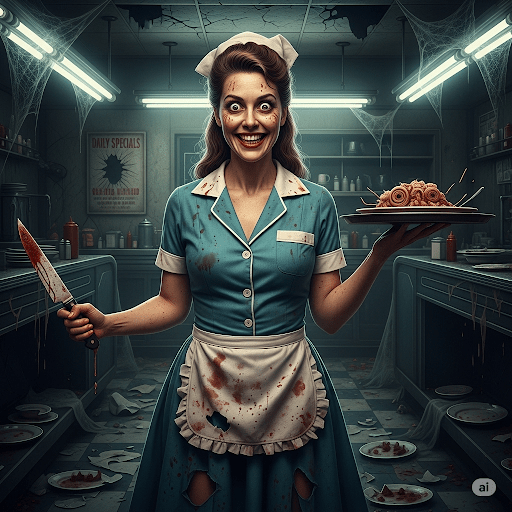
…was a waitress.
She worked in gastronomy (or hospitality, if you prefer) for several years. Waitressing was always a guarantee of earning money, although many felt that work was not the only price for a paycheck. Also sweat, blood and sanity. But when you are a student from a country where the average student income is €400 net, earning a few thousand euros in the summer sounds like an offer you can’t refuse.
She had already been to several countries where she earned extra money during her studies. She was rarely surprised by anything, as she experienced Dutch tourists in Austrian hotels (dirty people), British young men who were carried away by the low prices of beer in Europe (except Norway), Hungarian jerks or Italian irritants. She also experienced serving food for picky French people. Actually, she got to know all these stereotypes during her first summer.
Klary ran between the tables. Hands with plates flew from side to side, in one pocket a payment terminal, in the other pieces of paper with orders written on them. “… one Hansa, please…” asked a local old man for beer, “… and a sandwich with brunost…” another called out after her.
The raised voices of the customers no longer surprised her at all. She barely paused. “… I’ll have a veggie burger, please, but instead of dressing I want chipotle mayonnaise, instead of fries potatoes… and no cheese…” typical American, she thought.
None of this was new to her. That’s why she was surprised when she started to feel stressed. That feeling tingling the back of her head. She was sure that she hadn’t lied on her resume – stress resistance. Her logical part of her sanity told her that it was an ordinary workday – nothing special. “I guess I’m getting old.” she muttered to a co-worker who was sitting in the corner, hidden, enjoying a five-minute lunch break. “… it’s time to give up on gastro.”
Her colleague said nothing to her.
Klary walked over to the next table. “…please, do you have any wine… not dry, not sweet… something in between, but not fruity and…” She rattled off the lessons she had learned about wines. “I don’t know…” the French visitor hummed in her accent. Her English sounded terrible. “…and what kind of house wine do you have, miss?”
“Domaine du Tariquet.”
“And what kind is that?”
“Dry.”
“Very dry?”
I’m going crazy with them.
“Would you like to taste?”
“If I may ask.”
Klary ran to the wine fridge, took the one of dozens they had there, and ran to the table. She opened the bottle. And now, you can complain that the temperature is not right – Klary said to herself, but she kept quiet out of professionality. The Frenchwoman took a big sip, far from a sommelier’s tasting, and rinsed her crooked-toothed mouth with it. Klary nearly burst out laughing. The Frenchwoman obviously only had a French accent. Not even a trace of the elegance of Parisian cafes remained on the woman.
I’m going crazy about this.
When the wine was agreed upon, she refilled the glasses of a couple sitting on the edge of the space and went on to serve.
But the work began to pile up. During her journey with one glass of wine, she was stopped at four tables, where they dictated what else to order. Three ice creams – one apricot, the second lemon sorbet, the third should be chocolate, that is, if they have such a sorbet, if not, then sorbet, but not lemon. At one table, they shouted at her that they forgot to say they didn’t like tomatoes, and a Japanese guy with dusty hands waved at her. “Serviett, takk.”
The cook behind the counter gave her a confused look. “What’s sorbet?” he blurted out. Klary thought she was going to bite an artery out of his neck. She wasn’t bothered by the rush of work. She was bothered by the rush of stupidity.
“Miss, any local beer?”
“Hansa… from Bergen.”
“Something closer?”
“Sognapils from Leikanger.”
“And is it good?”
“It’s a local bestseller. Like Vestkyst IPA.”
“Anything else?”
“Bergen Pale Ale.”
“I want something typically Norwegian. Something… you know… that no one in Germany will say they drank.”
“We have akevitt. That’s Norwegian vodka, made from potatoes.”
“Great. Tell me more. I like local things. I’m a gastro-tourist, I taste where I go. I get to know the world through tastes, you know?”
Klary was pleased. She liked to talk. “Akevitt is made from potatoes and herbs. And you see, this bottle…” she took a bottle of Loiten Linie from the shelf, “… it has the departures and arrivals of ships written on it. Well, an old tradition says that vodka must mature in oak barrels and cross the meridian twice. The equator, you know, in English. Linie means the line it crosses. So if you want to experience something that is local and nowhere else, this is the right choice.”
“I’ll probably have a Coke, thanks.”
Well, kiss my ass, Klary thought.
“Please, and this is local…”
“Do you know which hike is the best…”
“I’m looking for a bar…”
“Aren’t you bored here, miss, so far from civilization? In this village?”
“And miss, don’t you know what to do here?”
“Do you recommend something to see here…”
“… and miss?”
***
They got off the main road and parked at a rest area near the Tjugum church. Ljukka looked questioningly at the driver. Driver sighted: “You seem to be the only one who doesn’t go crazy.” The driver leaned against the car and pulled a snuzz from the pocket of his waterproof jacket. With a strange hiss and covering his mouth, the driver pushed a tobacco pad between his cheek and gum. “Ufff… that kicks.” he muttered.
Ljukka saw that the object of his case was not far away.
He just didn’t expect so much mess around.
When he looked around, he saw the silhouettes of curious Dragsvičians in the windows of the surrounding houses. Ljukka was already well-known in the surrounding area, so when he showed up somewhere, it was definitely unusual business. And besides, when something drove him back to the Balestrand area, it had to be worth it.
The Tjugum church stood just below the road. The cemetery that surrounded it was sparse (not so many graves crowded together like in more populated corners). The wealthier ones, whose children had invested in marble tombs, were spared, but those who were just buried, even after death, experienced first-class service from young Klara.
The blonde girl was wearing a tattered shirt, her trousers rolled up below her knees. She was wearing only one shoe. Her hands were covered in dirt and soil. The surrounding graves had been dug up, and half-rotten corpses sat by wooden markers, leaning against each other, with some it was difficult to tell the state of decomposition. Only piles of bones remained.
“… I’ll bring it to you right away, sir… yes… I’m on my way… you, sir, excuse me, just a moment… I placed an order in the kitchen and… yes, you’ll get a discount for waiting.” and she laughed.
Crazy.
The skin on her face was stretched. The dimples in her cheeks seemed to have been hollowed out by a wedge. Her eyes were prominent, the veins on her neck and forehead bulged. She was moving her hands convulsively.
She was running from one side to the other. It seemed that the place by the bench was her “backroom”, where she took orders. There was also a body sitting there. It seemed to Ljukka that the waitress was talking to this one. The cook, or perhaps a coworker?
Ljukka looked around.
The sun was already setting. The last rays of sunlight shone through from behind Vindreken and Keipen.
He reached under his arm for the leather case.
Hold a cold grip of a gun.
“It won’t help you anymore,” he said.
***
When she had taken the last order, it was time to clock-out.
The shift was over.
 kabinett.blog
Pridaj komentár